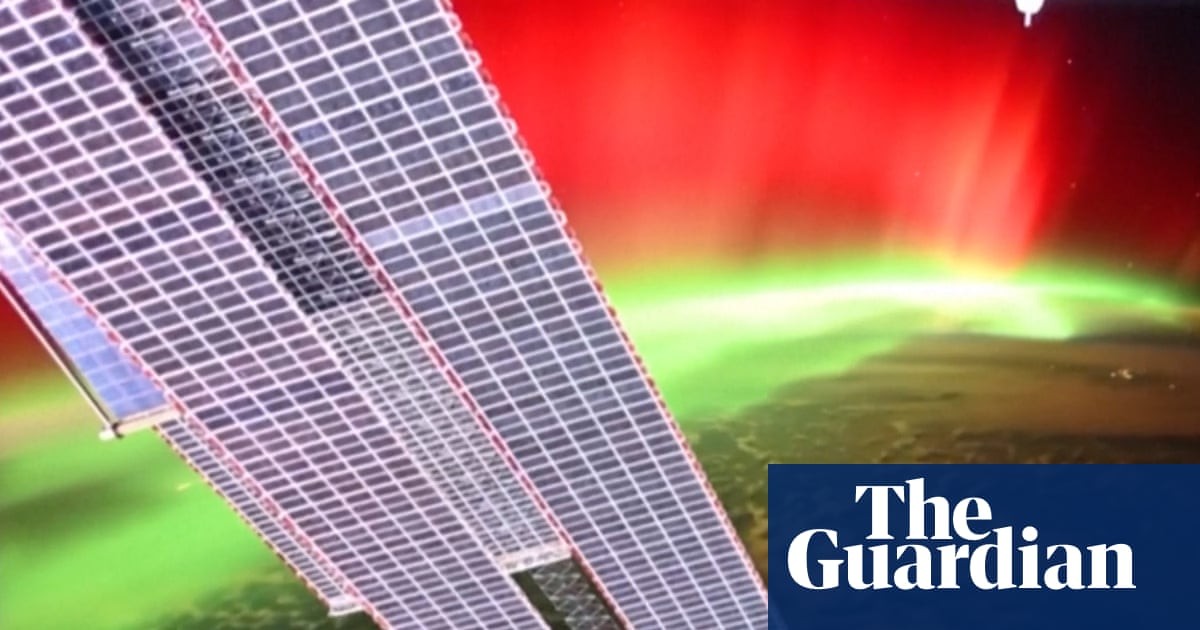
Cosmonaut Sergey Kud-Sverchkov of Russia’s Roscosmos captured breathtaking footage of the aurora borealis and australis from the International Space Station (ISS) during one of the most powerful geomagnetic storms in decades. The event, which peaked on January 20th, produced unusually vivid displays of light, including striking shades of red alongside the more typical green hues.
What Causes Auroras?
Auroras, often called the Northern and Southern Lights, are a natural phenomenon triggered by solar storms – intense bursts of energy and particles from the sun. When these charged particles collide with gases in Earth’s upper atmosphere (oxygen and nitrogen primarily), they excite those gases, causing them to emit light.
- Green is the most common color, produced by oxygen at lower altitudes.
- Red appears when oxygen is excited at higher altitudes, and is less frequent.
- Pink and violet shades come from nitrogen.
Why This Storm Was Exceptional
The storm that Kud-Sverchkov witnessed was particularly strong, creating auroras visible at unusually low latitudes. This meant people in regions normally outside the aurora zone (like parts of the United States and Europe) could see the lights with the naked eye.
“It felt as if we were literally sailing inside that light,” Kud-Sverchkov wrote on Telegram, describing the immersive experience from orbit.
This level of geomagnetic activity is rare. While solar storms occur regularly as part of the sun’s 11-year cycle, storms of this magnitude are less frequent. The intensity can disrupt radio communications and even damage satellites, though Earth’s magnetic field protects us from the most harmful radiation.
The visuals captured by Kud-Sverchkov provide a unique perspective on this powerful natural event, highlighting both its beauty and its potential impact on our technological infrastructure.