A new study led by researchers at Flinders University suggests that humanity is currently operating far beyond the planet’s natural ability to sustain us. While technological advancements have allowed the human population to soar, the research warns that we are effectively “borrowing” from the future by overexploiting finite resources.
Understanding Carrying Capacity
To understand the gravity of these findings, it is essential to define carrying capacity. In ecology, this term refers to the maximum number of individuals of a species that an environment can support long-term without depleting the resources necessary for survival.
The concept has an interesting historical parallel: it originated in the 19th-century shipping industry. As ships transitioned from sail to coal, “carrying capacity” was used to calculate how much cargo a vessel could hold without compromising the coal, water, and crew needed to actually power the ship.
Today, humanity faces a similar imbalance. We have used fossil fuels to artificially inflate our carrying capacity, allowing us to bypass natural limits—but at a significant cost to the planet’s stability.
The Gap Between Reality and Sustainability
The research team, led by Corey Bradshaw, distinguishes between two critical metrics:
1. Maximum Carrying Capacity: The theoretical absolute limit of humans the Earth could support, even under harsh conditions of famine, disease, and conflict. This is estimated at roughly 12 billion people.
2. Optimum Carrying Capacity: The population size that can be sustained while maintaining a decent standard of living and preserving ecological health. This number is much lower: 2.5 billion people.
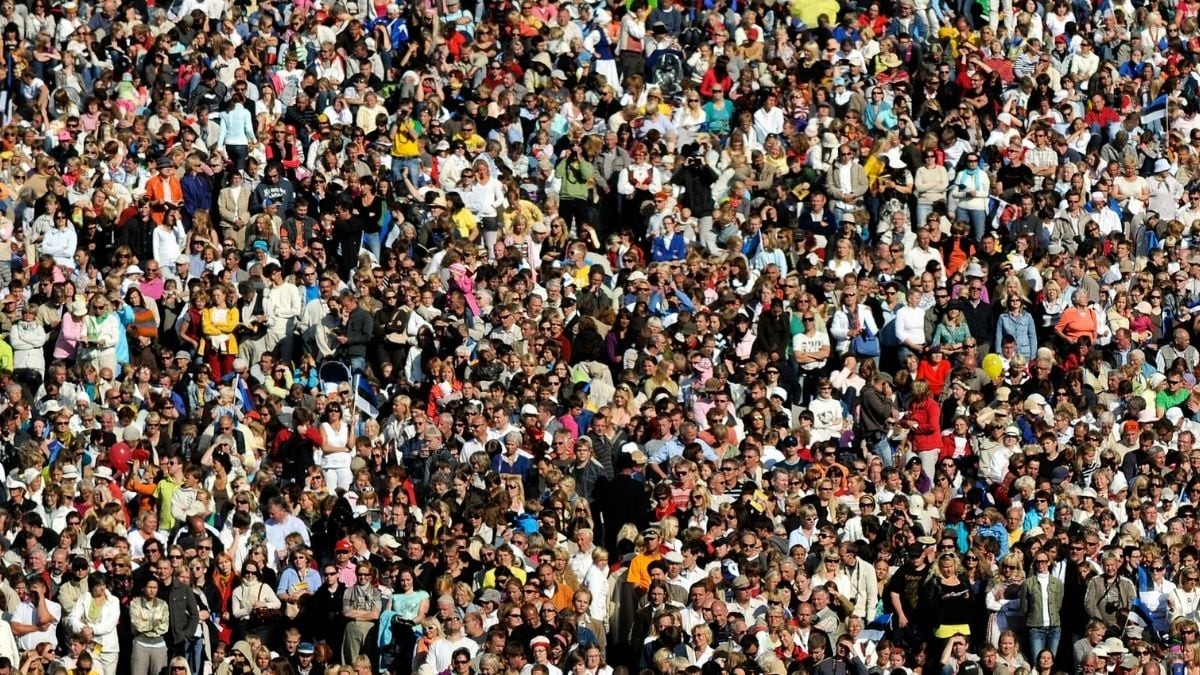
With the global population currently standing at approximately 8.3 billion, we are already nearly 6 billion people over the “optimum” threshold.
The Fossil Fuel “Buffer” and Its Consequences
The study highlights a dangerous trend: modern economies are built on the assumption of uninterrupted growth. This growth has been fueled by fossil fuels, which act as a temporary bridge, providing the energy needed for intensive agriculture (such as synthetic fertilizers) and global transport.
However, this “bridge” is creating severe ecological debt. The researchers note several critical warning signs:
– Resource Depletion: The UN has recently warned of a global “water bankruptcy.”
– Biodiversity Loss: Animal populations are crashing as they struggle to compete with humans for dwindling habitats and food sources.
– Climate Instability: The very fuels used to bypass natural limits are driving the climate change that disrupts the ecosystems we rely on.
Interestingly, the study suggests that total population size is a more significant driver of rising global temperatures and ecological footprints than the increase in individual per-capita consumption.
Looking Ahead: A Narrowing Window
While the data shows that the rate of population growth began to slow in the 1960s—entering what researchers call a “negative demographic phase”—the total number of people continues to climb. Current models predict the global population will peak between 11.7 and 12.4 billion by the late 2060s or 2070s.
The researchers emphasize that while the situation is dire, it is not yet irreversible. The study concludes that the Earth cannot sustain current or future populations without a fundamental shift in how we manage land, water, energy, and food.
“The Earth cannot sustain the future human population, or even today’s, without a major overhaul of socio-cultural practices,” the authors warn.
Conclusion
The study serves as a stark reminder that human technology has temporarily masked the planet’s biological limits, but it has not removed them. To avoid systemic instability, the global community must transition toward smaller populations and significantly lower consumption levels to align with the Earth’s regenerative capacity.