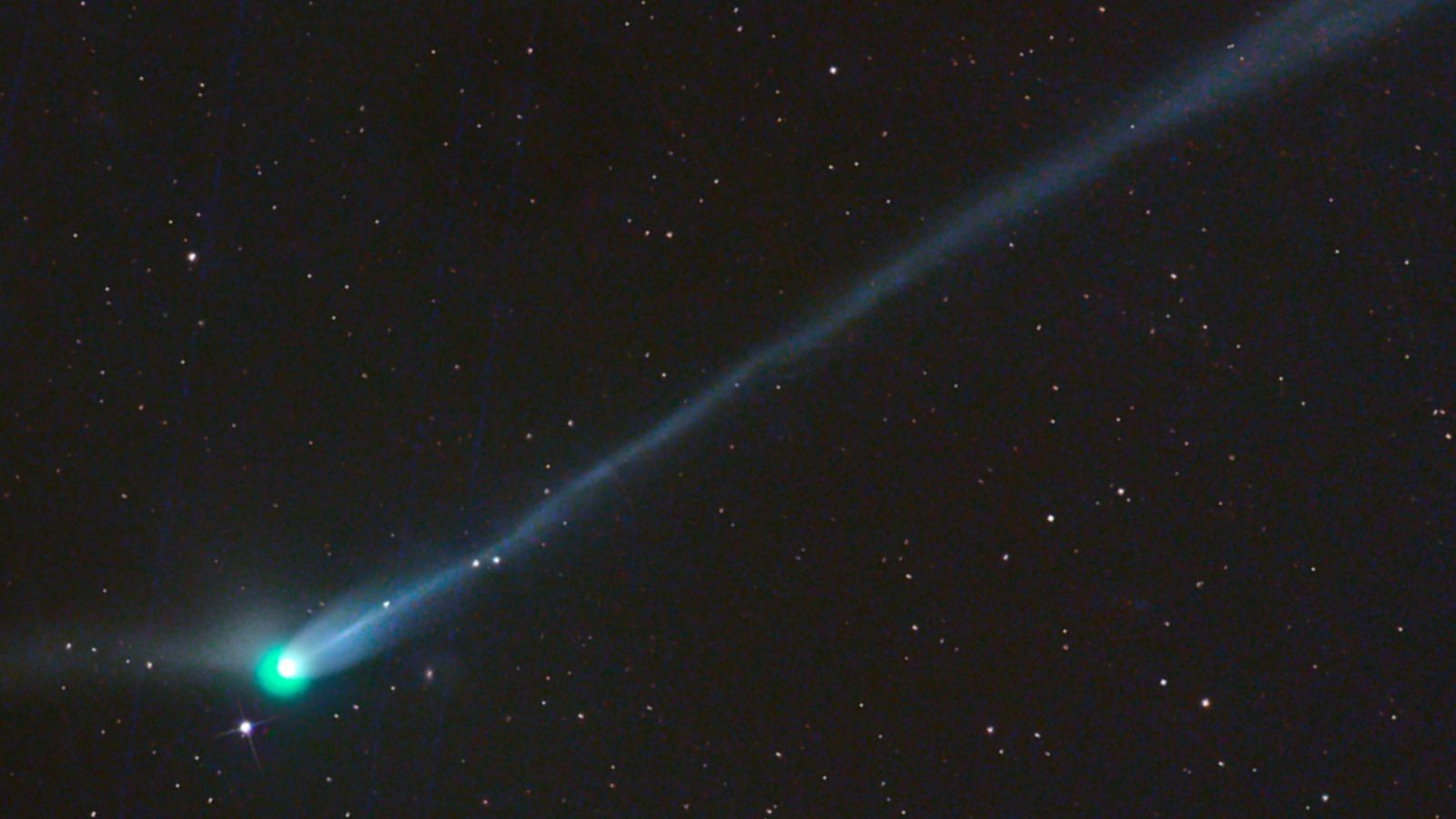
A newly discovered comet, roughly the size of a small city, is currently visible in the night sky as it approaches Earth. Dubbed C/2024 E1 (Wierzchoś), this icy body is on a hyperbolic trajectory, meaning it will soon be ejected from our solar system and drift into interstellar space—a fate shared by other comets like 3I/ATLAS. This ejection is not unusual; many comets originate from the distant Oort cloud and are flung out after a single pass through the inner solar system.
Discovery and Composition
The comet was first observed in March 2024 by Polish astronomer Kacper Wierzchoś, using a 4.9-foot telescope at the Mount Lemmon Observatory in Arizona. Subsequent observations by the James Webb Space Telescope (JWST) revealed substantial amounts of carbon dioxide in its coma—the cloud of gas and dust surrounding the icy core. Initial estimates put the comet’s diameter at approximately 8.5 miles, comparable to two-thirds the length of Manhattan, but more recent, unverified studies suggest this may be an overestimate.
Trajectory and Long-Term Fate
Comet Wierzchoś originated in the Oort cloud, a vast reservoir of icy objects at the solar system’s edge. Its hyperbolic orbit means it will not return for another visit. Experts estimate that the comet has been falling toward the sun for 1 to 3 million years and will be permanently expelled after its current solar slingshot. This process can take decades or centuries to complete, after which it will wander through the Milky Way for millions or billions of years.
This is not an isolated event: other comets, such as 3I/ATLAS, have already been ejected from our solar system, demonstrating a natural phenomenon where icy bodies are kicked out by gravitational forces.
Visibility and Future Cometary Events
While not visible to the naked eye, Comet Wierzchoś can be observed with telescopes or binoculars. Its coma glows green due to its high carbon content, a rare but observed phenomenon in comets. The best viewing opportunities are from the Southern Hemisphere, though it remains observable in the Northern Hemisphere over the next few weeks.
Looking ahead, 2026 promises additional cometary events. Astronomers have already spotted C/2026 A1 (MAPS), a “sungrazer” that could become bright enough to see with the naked eye, and C/2025 R3 (PanSTARRS), another potential naked-eye comet expected in late April.
In summary: Comet C/2024 E1 (Wierzchoś) is a rare and striking celestial visitor, destined for permanent exile from our solar system, highlighting the dynamic nature of cometary orbits and the vastness of interstellar space.