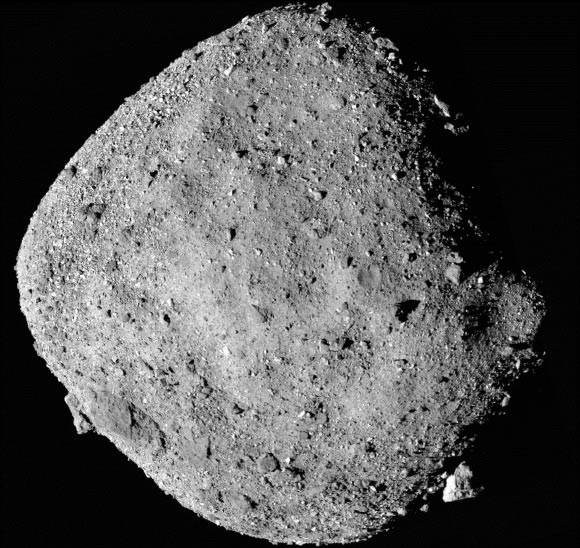
New analysis of samples returned by NASA’s OSIRIS-REx mission has revealed that the asteroid Bennu is not a uniform mass of rock, but a complex patchwork of distinct chemical environments. By examining the asteroid at a nanoscale, scientists have discovered that organic compounds and minerals are clustered into specific “domains,” suggesting that water once interacted with the asteroid in highly localized, uneven ways.
The Advantage of Pristine Samples
For decades, scientists have studied meteorites to understand the early Solar System. However, meteorites face a significant hurdle: the intense heat of atmospheric entry and potential contamination from Earth’s environment can alter their chemical makeup.
The samples from Bennu change this equation. Because they were collected directly from space and returned via a controlled mission, they are considered genuinely pristine. This allows researchers to study the “original” chemistry of the early Solar System without the interference of terrestrial or atmospheric changes.
Precision at the Nanoscale
Using advanced techniques—specifically nanoscale-infrared and Raman spectroscopy —researchers from Stony Brook University were able to map the chemical composition of a specific sample (OREX-800066-3) at resolutions as fine as 20 to 500 nanometers per pixel.
To protect the integrity of these irreplaceable materials, the team employed two critical strategies:
– Atmospheric Isolation: All measurements were conducted without exposing the sample to air, preventing the oxidation or alteration of sensitive organic functional groups.
– Non-destructive Testing: The methods used allowed scientists to observe the sample’s structure without destroying it, preserving the material for future study.
A Patchwork of Chemistry
The study identified several distinct chemical regions within the sample, including:
– Aliphatic-rich domains (carbon-based chains)
– Carbonate-rich domains
– Nitrogen-bearing organic-rich domains
The existence of these separate clusters proves that the “aqueous alteration”—the process where liquid water reacts with rock—was chemically heterogeneous. Instead of soaking through the asteroid like a sponge, water likely moved through cracks or pockets, creating unique chemical “neighborhoods” within the asteroid’s structure.
Why This Matters for the Origins of Life
Perhaps the most significant finding is the survival of nitrogen-bearing organic functional groups. Nitrogen is a fundamental building block of amino acids and DNA. The fact that these sensitive molecules survived the process of water-driven alteration is a major breakthrough for astrobiology.
This discovery raises two vital questions for planetary science:
1. How is organic complexity preserved? It shows that complex molecules can survive even when a small planetary body undergoes significant chemical changes.
2. Did asteroids seed Earth? If these nitrogen-rich organics can survive the harsh environments of asteroids, it strengthens the theory that carbonaceous asteroids may have delivered the necessary “prebiotic” ingredients to early Earth, potentially jumpstarting the chemical processes that led to life.
“These findings demonstrate that the survival of chemically sensitive organics through aqueous alteration has direct implications for how organic complexity is built up and preserved in primitive planetary materials.” — Professor Mehmet Yesiltas, Stony Brook University
Conclusion
The heterogeneous chemical landscape of Bennu proves that water once played a transformative, localized role in shaping the asteroid. By preserving complex, nitrogen-rich organic matter, Bennu serves as a vital link in understanding how the building blocks of life may have been transported across the Solar System.