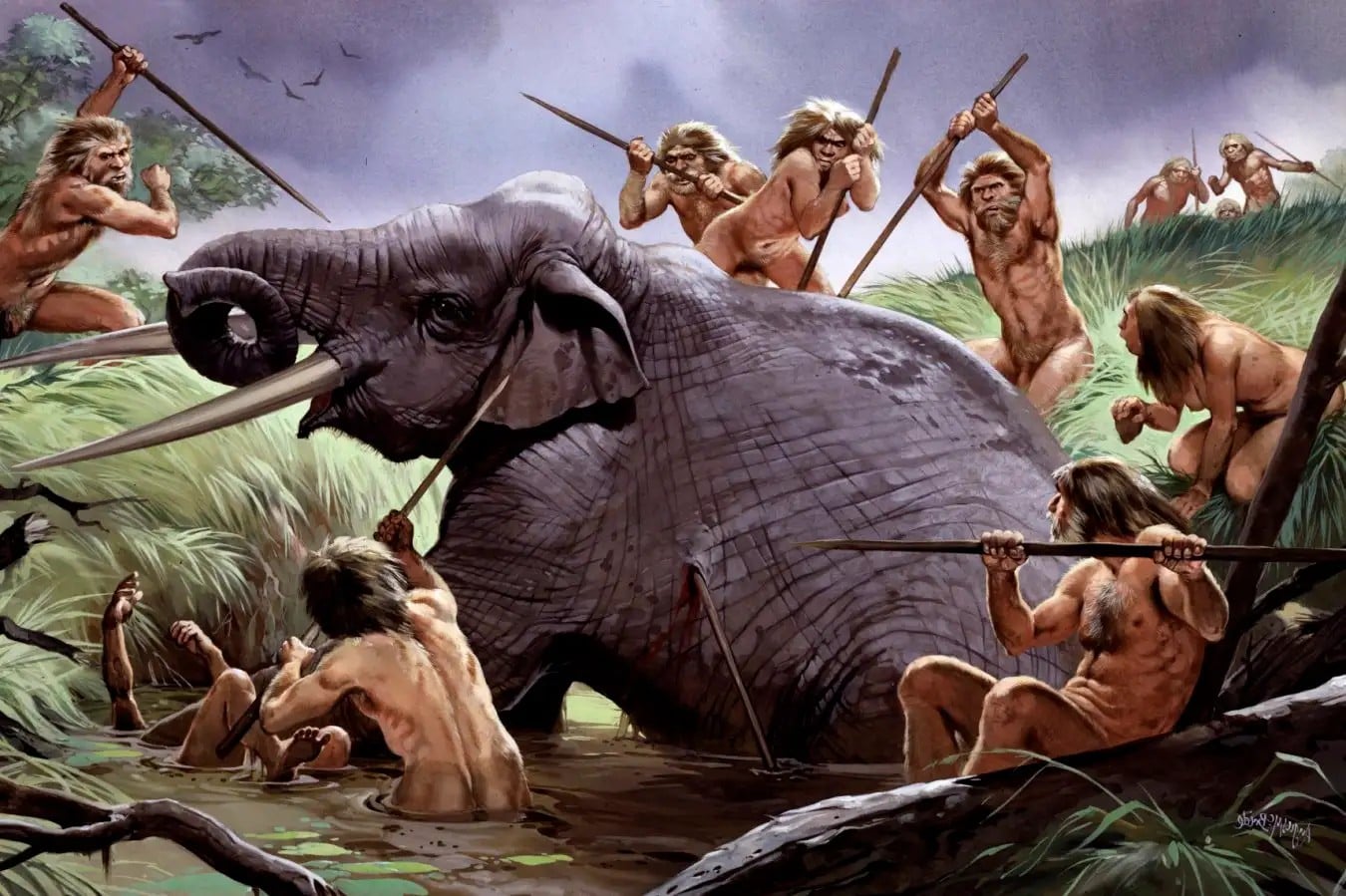
New evidence suggests that ancient humans were butchering elephants nearly 1.8 million years ago, a feat that required advanced tools, coordinated effort, and a substantial reward in protein. Researchers led by Manuel Domínguez-Rodrigo at Rice University in Texas have uncovered a site at Olduvai Gorge in Tanzania that points to this early mastery of large-game processing.
The Shift to Big Game
For over a million years, early humans primarily hunted smaller game like gazelles and waterbucks. Around 2 million years ago, this changed. At Olduvai Gorge, a fossil-rich region spanning 2 million to 17,000 years of hominin activity, researchers observed a sudden increase in elephant and hippo remains beginning around 1.8 million years ago. However, confirming that humans actively butchered these massive animals proved challenging.
The key breakthrough came with the discovery of the EAK site. This site contained the remains of Elephas recki, an extinct elephant species, alongside significantly larger and heavier stone tools than those previously used by hominins. Domínguez-Rodrigo notes that these “Pleistocene knives” remained remarkably sharp even after excavation.
Evidence of Butchery
The team determined that the elephant bones had been broken shortly after death – while the bone was still fresh (“green”). While scavengers like hyenas can consume flesh, they cannot break the thick limb bones of adult elephants. The researchers found evidence of hammerstone-induced fractures on several bones, confirming human involvement in the butchering process.
Notably, the bones lacked clear cut marks from meat removal, leaving open the question of whether the humans killed the elephant or scavenged a carcass. However, the presence of green fractures and associated tool marks strongly suggests active butchery.
Implications Beyond Tools
This discovery isn’t just about better tools; it indicates broader social and cultural changes among early hominins. Domínguez-Rodrigo argues that butchering elephants required larger, more coordinated groups, driving shifts in hominin behavior. The transition suggests that Homo erectus, the likely toolmaker, was capable of tackling formidable prey.
Debate and Further Research
Not all researchers agree with the interpretation of the EAK site. Michael Pante at Colorado State University argues that the evidence is weak, relying heavily on proximity between tools and bones and the assumption of human-made fractures. He points to the HWK EE site, dating back 1.7 million years, as providing stronger evidence, with bones bearing clear cut marks alongside thousands of other artifacts.
Despite the debate, the EAK site offers compelling evidence that early humans were capable of processing elephants by at least 1.78 million years ago. This advancement in tool use and cooperative hunting marks a significant milestone in human evolution.
The ability to exploit large game such as elephants fundamentally changed early human diets and behaviors, providing a substantial caloric boost. This was a pivotal step in human development.