Space photo of the day for May 7, 2026.
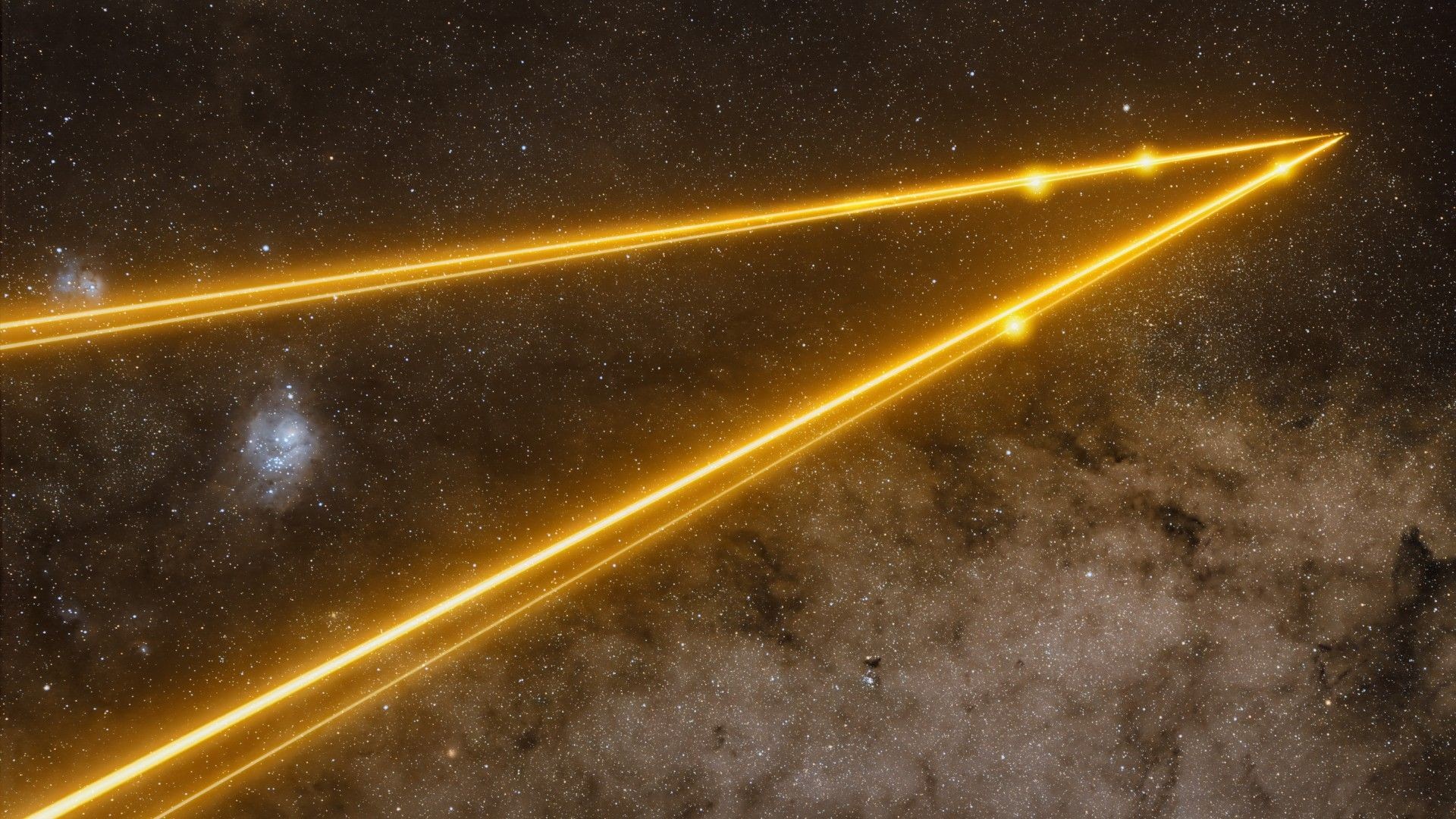
Four glowing beams slicing through the void.
Converging at the center of our galaxy
Looks like Star Wars.
It’s not.
Real science.
The European Space Observatory’s Very Large Telescope in Chile is behind it. Four giant Unit Telescopes firing lasers into the night.
The Artificial Stars
What is actually happening here?
The UTs aren’t blasting the galaxy. They’re shooting straight up. Into the atmosphere.
About 56 miles (90 km) overhead, they create what ESO calls artificial stars.
Why?
The Earth’s air is chaotic. Always changing. Distorting light on its way in.
If you want to see clearly, you need to know what the turbulence looks like.
These lasers give scientists that map.
The telescope watches how the beams shake. Then it fixes its own optics in real-time. Canceling out the blur. Making sure the cosmos stays sharp.
The Details Matter
The image looks clean though. Doesn’t it?
Four lasers piercing space itself. Meeting right around the supermassive black hole at the Milky Way’s heart.
But look closer.
See those four glowing blobs sitting on the lasers near the convergence point?
Clouds. Just plain, mundane clouds caught in the beam’s path.
The light hits them and flares.
It’s easy to miss.
Even smaller though are the true targets. Right where the beams appear to connect? Tiny dots. Hardly visible.
That’s the artificial star itself. High up in the sky. The reference point that makes all of this possible.
Is it pretty? Sure. But the real story isn’t the lasers. It’s the math fixing the atmosphere, one photon at a time.