


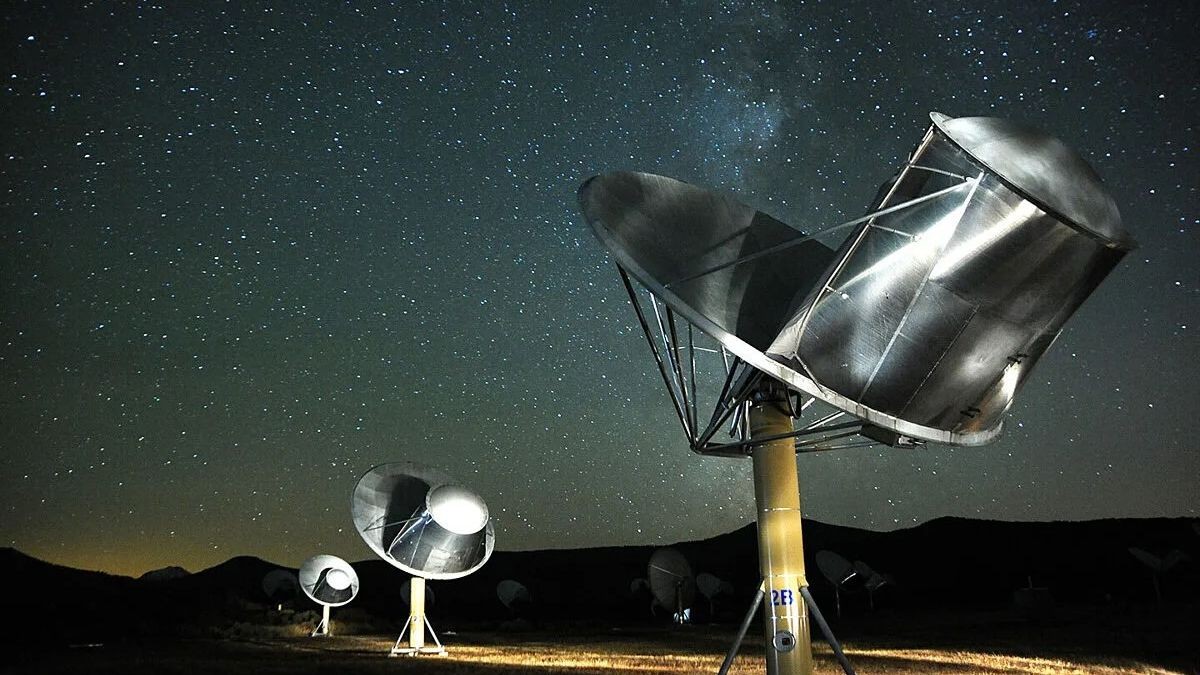
For decades, the Search for Extraterrestrial Intelligence (SETI) has scanned the cosmos for signs of alien life, yet the universe remains eerily quiet. A new study suggests that stellar activity – or “space weather” – could be scrambling potential alien transmissions, making them undetectable to our instruments. This means that even if other civilizations are broadcasting signals, they may be masked by the chaotic electromagnetic environments around their stars.
The Problem With Stellar Interference
Stars aren’t static beacons; they erupt with flares and coronal mass ejections (CMEs) that release vast amounts of plasma and electrons into space. These charged particles wreak havoc on radio signals, especially the narrow-band frequencies SETI researchers prefer. When a radio wave encounters plasma, it bends and spreads out, weakening the signal and making it harder to distinguish from background noise.
Scientists already account for interference from interstellar gas, but the effects of space weather around other stars haven’t been quantified until now. The study’s authors, Vishal Gajjar and Grayce Brown of the SETI Institute, wanted to determine just how much stellar activity could distort alien signals before they reach Earth.
Simulating the Silence
To do so, the researchers analyzed radio signals between Earth and spacecraft in our solar system to measure how solar flares and CMEs affect transmissions. They then used this data to simulate how space weather would impact signals from sun-like stars and red dwarfs (the most common type of star in our galaxy).
The results were sobering. Up to 70% of stars could broaden signals by more than one Hertz, and 30% by over ten Hertz. A powerful CME could even smear a narrowband signal across over 1,000 Hertz, effectively erasing it from detection.
Tuning Our Ears to the Cosmos
The implication is that we may be filtering out alien signals without even knowing it. However, this problem isn’t unsolvable. Just as we correct for interstellar distortion, we can adjust our search algorithms to account for stellar interference.
The study’s authors argue that the universe may not be silent at all, but rather noisy with transmissions that we’ve been missing. The lack of detected signals could be a result of our own limitations, not necessarily the absence of extraterrestrial civilizations.
After 66 years of searching, SETI has yet to confirm the existence of alien technology. The new study suggests that space weather could be a key piece of this puzzle, and understanding this interference may be critical to finally breaking the “Great Silence.”


