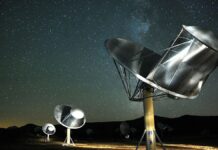
Earth’s search for extraterrestrial intelligence (SETI) may be hampered by unpredictable space weather, making it harder to detect alien transmissions. A new study suggests that stellar activity, such as solar storms and plasma turbulence, can distort radio signals from distant stars, potentially explaining why we haven’t heard from other civilizations.
The Problem with Cosmic Static
The SETI Institute, funded in part by NASA, has found that signals from transmitting planets can be broadened by stellar activity, spreading their power across more frequencies. This makes them harder to detect using traditional narrowband searches—the standard method for identifying artificial signals.
The issue is not that aliens aren’t trying to reach us, but that their messages may be garbled by the time they arrive. According to SETI astronomer Vishal Gajjar, a signal that starts narrow can be “smeared” by its star’s environment, dropping below detection thresholds.
This phenomenon occurs because plasma fluctuations in stellar winds and eruptive events (like coronal mass ejections) can distort radio waves near their source. In simpler terms, the weather on other stars could be interfering with our ability to pick up their transmissions.
Rethinking the Search for Life
For decades, SETI has scanned the heavens for spikes in frequency that would indicate artificial signals. But this new research highlights a previously overlooked complication: even if aliens transmit a perfectly narrow signal, it may not remain that way by the time it reaches Earth.
To reach this conclusion, researchers calibrated the effects of stellar activity using radio transmissions from spacecraft in our solar system and extrapolated the findings to distant stars. This means future searches may need to adapt, potentially by observing at higher frequencies.
As SETI research assistant Grayce C Brown puts it, scientists must design searches that match what actually arrives on Earth, not just what might be transmitted.
The Bigger Picture: UFOs, Government Claims, and Public Debate
The search for extraterrestrial life is entwined with broader public fascination with unidentified flying objects (UAPs). The past year has seen a flurry of claims and speculation, including unsubstantiated reports of government injuries from alien encounters, accusations of secret Pentagon programs reverse-engineering crashed UFOs, and even contradictory statements from high-profile figures.
In 2024, a former defense department official testified before Congress about such injuries, while whistleblower David Grusch alleged a decades-long government cover-up. Despite skepticism from some officials, like Congressman Tim Burchett, the narrative persists: the U.S. government may possess unexplained technology that defies current physics.
Government reports show over 750 new UAP sightings reported between May 2023 and June 2024, fueling public curiosity. Even former President Barack Obama briefly stoked the debate, claiming aliens “were real” before quickly backtracking. Donald Trump has also weighed in, promising to declassify government records on the topic.
The question of whether humans are alone in the universe remains one of mankind’s greatest mysteries, and the possibility of extraterrestrial contact continues to captivate the public imagination.
Ultimately, the new SETI research underscores a critical point: even if alien civilizations exist and are attempting to communicate, natural phenomena may be obscuring their signals. The search for life beyond Earth will require not just technological advancement but also a deeper understanding of the cosmic environment itself.