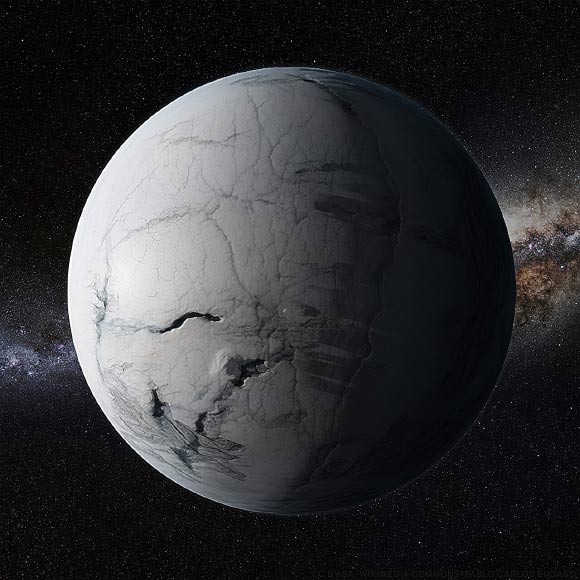
New research reveals that even during the most extreme ice age in Earth’s history – the Sturtian glaciation (717-658 million years ago) – the planet’s climate wasn’t entirely frozen still. Scientists studying ancient rocks in Scotland have found evidence of annual, decadal, and centennial climate cycles persisting despite the near-total global ice cover. This means that familiar patterns like seasons, solar cycles, and even El Niño-like oscillations still operated in a world where most of the ocean was frozen.
The Evidence: Layered Rocks as Time Capsules
The study, led by Professor Thomas Gernon at the University of Southampton, examined 2,600 individual layers of sediment from the Port Askaig Formation on the Garvellach Islands. Each layer represents a single year of deposition, effectively creating a detailed historical record of climate conditions. These rocks are remarkable because they preserve the full range of climate rhythms we know from today: annual seasons, solar cycles, and interannual oscillations. The researchers discovered these cycles through microscopic analysis of the rock layers, which likely formed from seasonal freeze-thaw cycles beneath ice cover.
Why This Matters: Challenging Our Understanding of Extreme Climate
This discovery is significant because it challenges the long-held assumption that climate variability was suppressed during Snowball Earth. Until now, it was unknown whether such oscillations could even exist within a fully frozen planet. The fact that they did suggests that even small openings in the ice cover could allow familiar climate modes to reemerge. Climate simulations confirm this: as little as 15% of the ocean surface remaining ice-free could trigger atmosphere-ocean interactions similar to those seen today.
The ‘Slushball’ Scenario: A More Dynamic Snowball Earth?
The findings support the idea that Snowball Earth wasn’t a static, completely frozen state. Instead, it was likely punctuated by periods where small patches of open ocean emerged, allowing climate variability to persist. These periods, sometimes called ‘slushball’ or ‘waterbelt’ states, suggest that the planet was more dynamic than previously thought, even during its deepest freeze.
“These rocks are extraordinary,” said Dr. Chloe Griffin, co-author of the study. “They act like a natural data logger, recording year-by-year changes in climate during one of the coldest periods in Earth’s history.”
In conclusion, this research shows that Earth’s climate system has an inherent tendency to oscillate, even under the most extreme conditions. The discovery of climate cycles within Snowball Earth suggests that even a partially frozen planet can experience familiar weather patterns, reshaping our understanding of how ice ages operate.
Source: Griffin, C., Fu, M., & Gernon, T. (2026). Interannual to multidecadal climate oscillations occurred during Cryogenian glaciation. Earth and Planetary Science Letters, 679, 119891. https://doi.org/10.1016/j.epsl.2026.119891