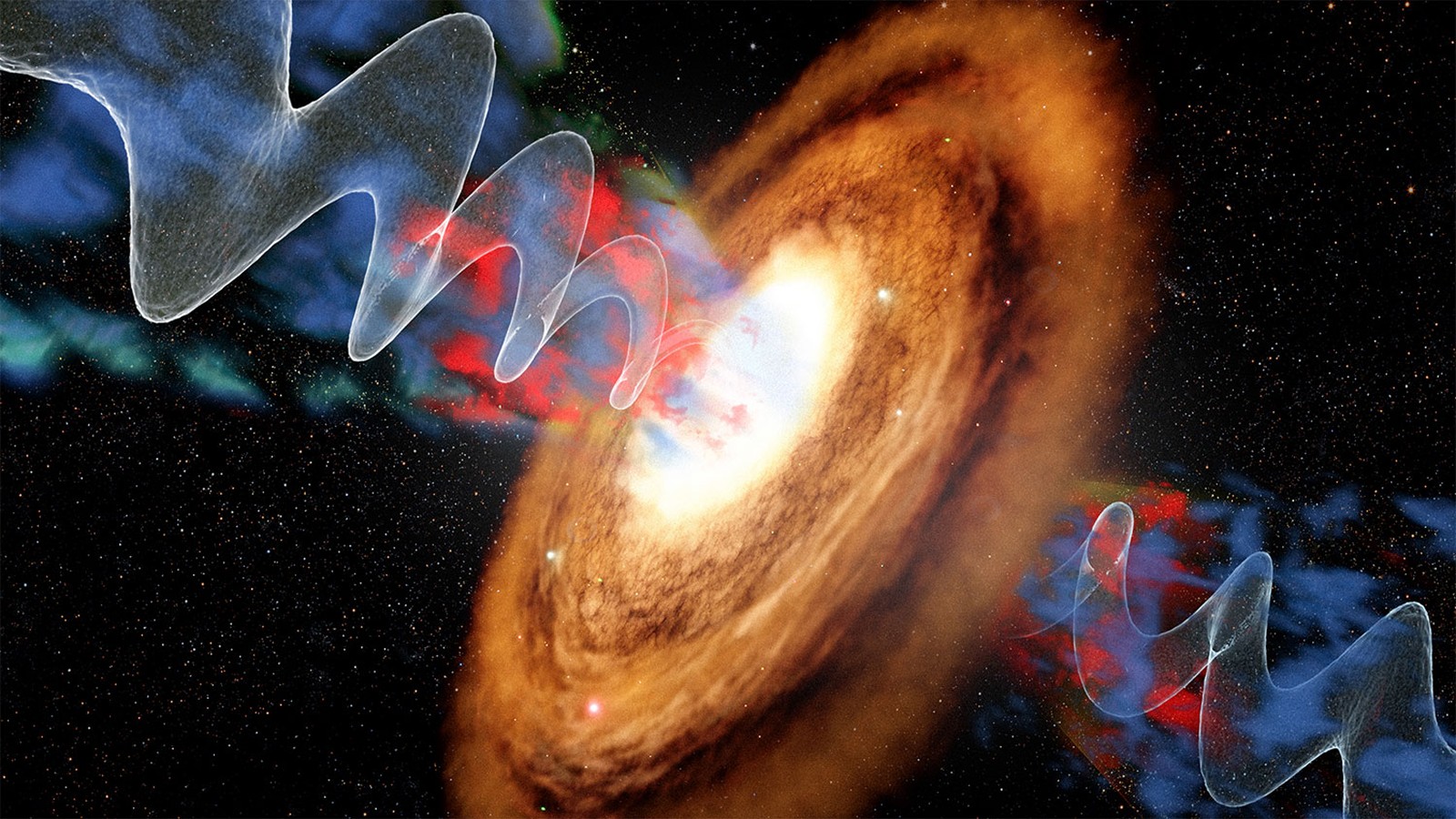
Astronomers have discovered an unprecedentedly large and dynamic jet emanating from a supermassive black hole (SMBH) in the nearby galaxy VV340a. This jet, stretching up to 20,000 light-years, exhibits a rare “wobbling” pattern and is actively reshaping its host galaxy in ways previously unseen. The findings, published in Science, challenge conventional understanding of galactic evolution and raise new questions about the Milky Way’s own history.
The Scale of the Discovery
SMBHs are central to how galaxies grow. Their immense gravity pulls in surrounding matter, forming an active galactic nucleus (AGN) that can briefly outshine entire star systems. Some SMBHs also launch jets of superheated material at near-light speed. While these jets are known, the one observed in VV340a is exceptional in both size and behavior.
The team, led by researchers at UC Irvine and Caltech, combined data from the W. M. Keck Observatory, the James Webb Space Telescope (JWST), and the Karl G. Jansky Very Large Array (VLA) to analyze the jet. The Keck Cosmic Web Imager (KCWI) revealed the jet’s full extent, while JWST showed the extreme energy levels at its source. Radio observations from the VLA confirmed the jet’s helical twist and unsteady direction.
“The Keck Observatory data is what allowed us to understand the true scale of this phenomenon,” said Justin Kader, the lead author. “Without these observations, we wouldn’t know how powerful—or how persistent—this outflow really is.”
Unexpected Galactic Impact
The jet isn’t just large; it’s actively suppressing star formation in VV340a by stripping gas at an alarming rate of 20 times the mass of our Sun per year. What makes this discovery even more surprising is that it was observed in a relatively young galaxy undergoing a merger. Such powerful jets are usually found in older, more settled galaxies.
The team also observed a massive “corona” of superheated plasma extending thousands of parsecs from the black hole, far exceeding the size of any previously documented coronal structure. The jet’s wobble, or precession, suggests a complex dynamic at play. This precession is not just a quirk but a key factor in how the jet influences its surroundings.
Implications for Galactic Evolution
The discovery forces scientists to rethink how SMBHs and galaxies co-evolve. If such violent outflows can occur in young, merging galaxies, the Milky Way might have experienced similar events in its past, even if there is no clear evidence of them today.
“This is the first time we’ve seen a precessing, kiloparsec-scale radio jet driving such a massive outflow in a disk galaxy,” Kader explained. “It changes the way we think about the galaxy we live in.”
The team is now investigating whether a second SMBH at the center of VV340a could be causing the jet’s wobble, which would further complicate the picture. This discovery opens a new era in understanding galactic transformation, proving that even at cosmic scales, things are rarely as predictable as they seem.
The research underscores the importance of combining data from multiple powerful observatories to reveal the hidden dynamics of the universe. Ultimately, this finding highlights how much remains unknown about galactic evolution and the role of SMBHs in shaping the cosmos.