


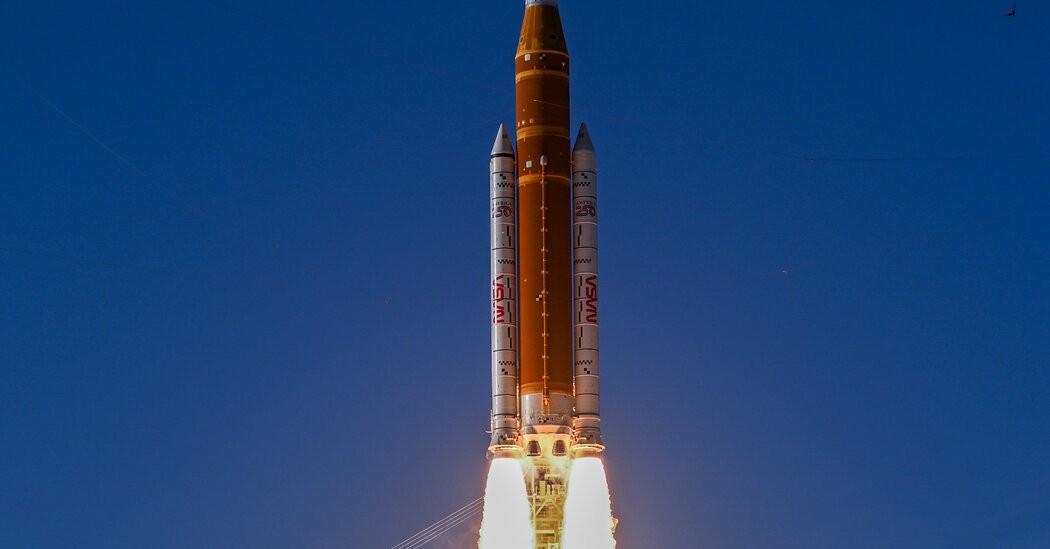
The four-person crew of Artemis II has successfully initiated its journey toward the moon, propelled by a powerful engine burn that locked them onto a trajectory for a lunar flyby. The mission, consisting of three Americans and one Canadian astronaut, is not a landing mission but a critical test flight designed to validate systems for future lunar landings.
Engine Burn and Crew Confirmation
At 7:49 p.m. Eastern time, Orion’s main engine fired for nearly six minutes, committing the crew to a four-day lunar trajectory. NASA confirmed the burn was “flawless” and that the spacecraft, dubbed “Integrity” by the crew, is performing as expected. Astronaut Christina Koch emphasized the mission’s intent: “With this burn to the moon, we do not leave Earth; we choose it.”
The crew spent the first day in a higher-than-usual Earth orbit, conducting extensive system checks. Mission specialist Jeremy Hansen affirmed the collaborative spirit behind the mission: “Humanity has once again shown what we are capable of, and it’s your hopes for the future that carry us now on this journey around the moon.”
Mission Objectives and Future Implications
The primary goal of Artemis II is to simulate maneuvers needed for docking with a lunar lander, a critical step for upcoming landing missions. NASA officials report that these tests have yielded positive results, with life support systems performing “exactly as we predicted, and in some cases, better.” These tests are crucial because they directly inform the design of future spacecraft that will carry astronauts to the lunar surface.
Crew Dynamics and Living Conditions
The crew is adapting to the unique challenges of space travel, including a lack of privacy in the cramped capsule. Astronaut Victor Glover noted that the team has developed a camaraderie through extended training in confined spaces. To cope with the zero-gravity environment, the astronauts are utilizing a flywheel exercise system, which provides resistance through a pulley mechanism, and converting seats into makeshift sleeping quarters.
Ongoing Tracking and Communication
NASA will continue streaming the mission via YouTube, X, and its website, providing real-time updates on the crew’s progress. The astronauts will also engage in video conferences with family and mission support teams throughout the journey.
The Artemis II mission represents a significant step in NASA’s renewed commitment to lunar exploration, laying the groundwork for sustained human presence on the moon and beyond. The crew is scheduled to splash down in the Pacific Ocean in eight days, completing a journey that reaffirms humanity’s ability to reach for new frontiers.


