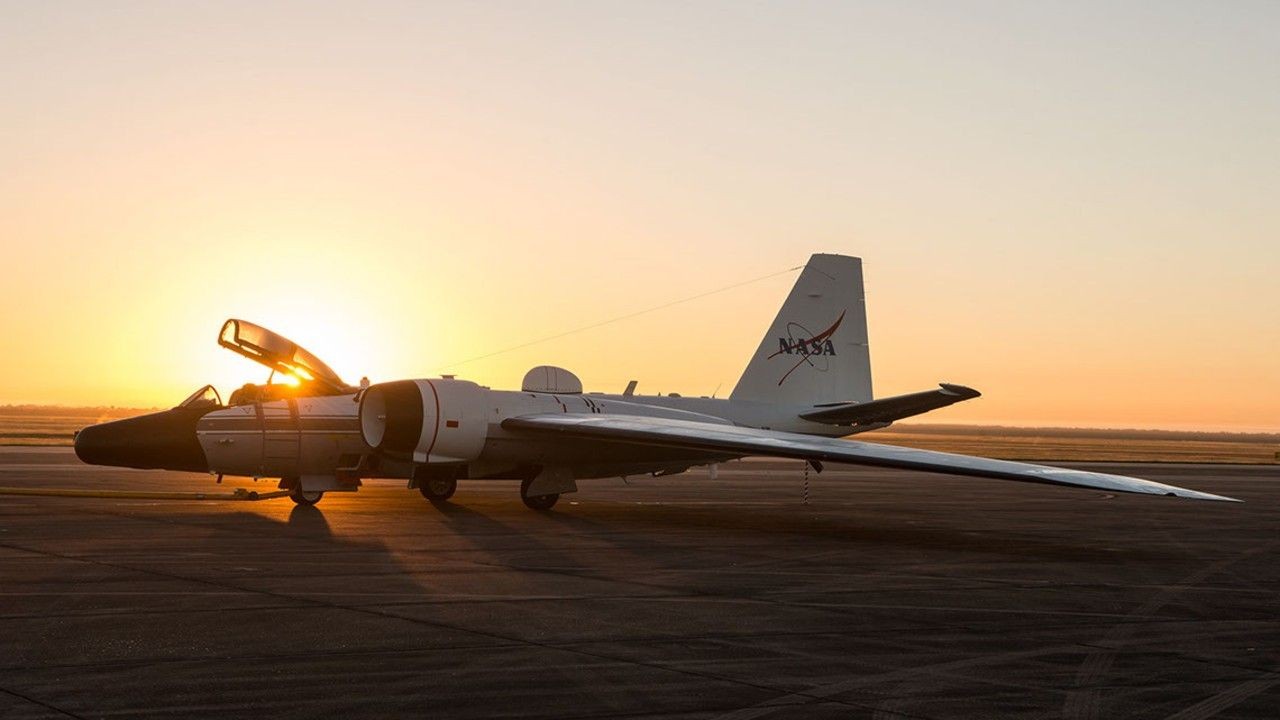
A NASA research aircraft landed without its wheels Tuesday at Ellington Field in Houston, resulting in a dramatic, fiery skid across the runway. All crew members emerged safely, despite the visible damage to the plane.
Incident Details
The incident involved one of NASA’s three WB-57 research jets. Video footage circulating online shows the aircraft touching down on its belly, trailing smoke and flames. NASA officials have confirmed a mechanical issue caused the landing gear to fail. The exact nature of this problem is still under investigation.
NASA spokesperson Bethany Stevens stated via social media that an investigation is underway and updates will be released as more information becomes available. First responders quickly assisted the crew in exiting the cockpit after the plane came to a stop.
The WB-57 Aircraft
The WB-57 is a modified version of the Martin B-57 Canberra, originally designed in 1953 as a bomber and reconnaissance plane for the U.S. Air Force. These aircraft saw heavy use during the Vietnam War for intelligence gathering. NASA now uses them for high-altitude research, capable of flying up to 63,000 feet (19 kilometers) with a range of 2,500 miles (4,000 km).
Interestingly, two of NASA’s three WB-57s were undergoing inspections, leaving the aircraft that crashed as the only one recently in operation. The planes are stationed at Ellington Field near the Johnson Space Center.
Unique Capabilities
Due to its bomber origins, the WB-57 can carry substantial payloads—up to 8,800 lbs (4,000 kilograms)—making it valuable for scientific experiments, including eclipse studies. The aircraft’s versatility is a key reason why NASA continues to operate this aging but capable platform.
The incident highlights the risks inherent in high-altitude research, but ultimately underscores the safety protocols in place that ensured no injuries occurred. NASA will conduct a thorough review to prevent similar accidents in the future.