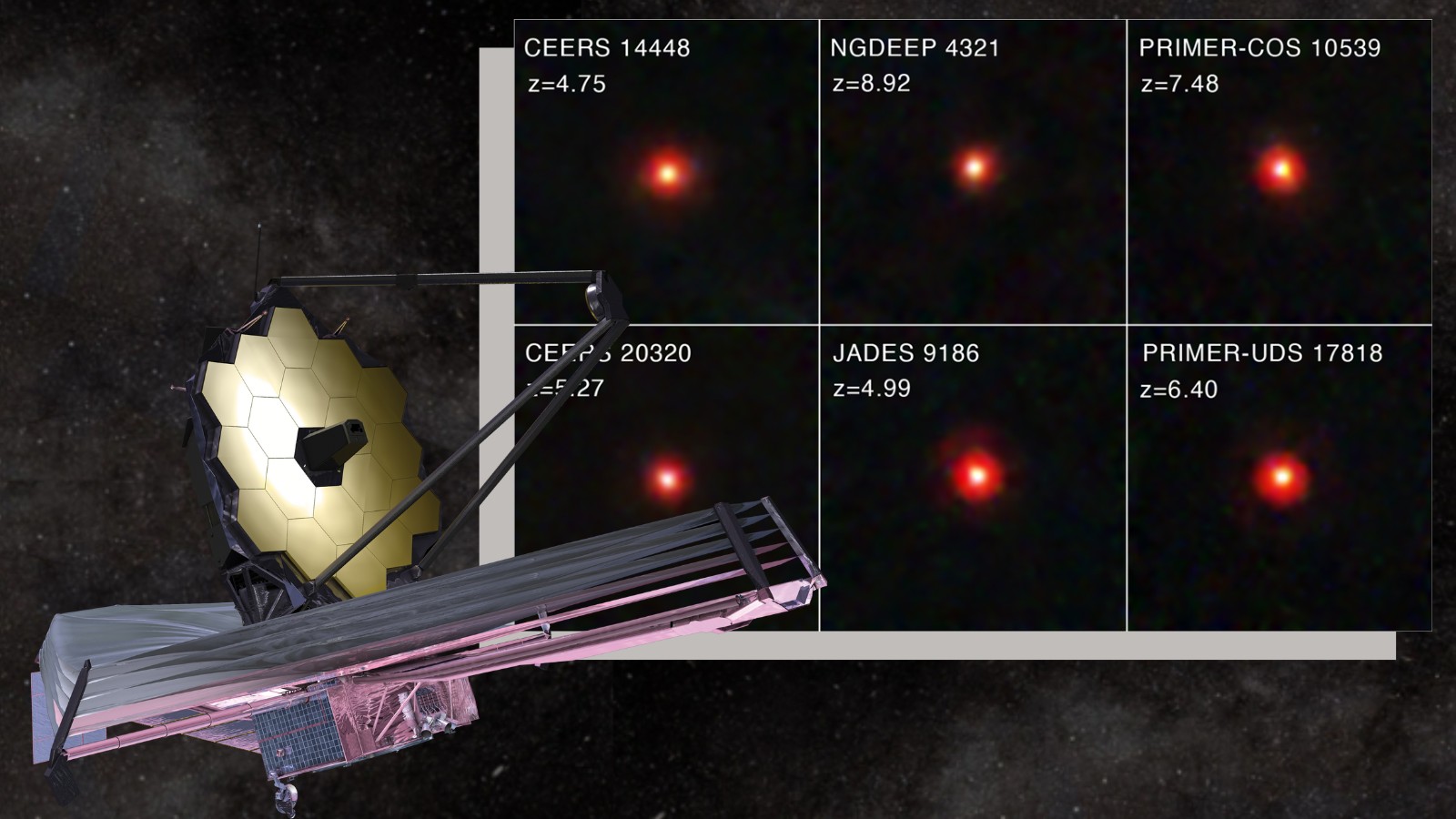
The James Webb Space Telescope (JWST) continues to reshape our understanding of the early universe, and its latest observations have led to a compelling new hypothesis regarding a mysterious class of objects known as “Little Red Dots” (LRDs). Initially suspected to be powered by distant, rapidly growing black holes, emerging evidence suggests these fiery pinpricks may instead represent globular clusters in the process of formation – essentially, baby galaxies under construction.
The Mystery of the Little Red Dots
LRDs were identified in JWST data as extremely distant objects whose light has been stretched by the expansion of the universe, allowing astronomers to observe them as they existed billions of years ago. These objects exhibit a unique “V-shaped” spectrum, with a sharp contrast between blue ultraviolet and red optical wavelengths. The initial assumption was that this spectral signature was indicative of supermassive black holes actively consuming matter. However, detailed analysis has revealed that LRDs possess properties that deviate significantly from known black hole populations, prompting a reevaluation of their true nature.
A Bold New Theory: Proto-Globular Clusters and Supermassive Stars
A team of researchers proposes that LRDs are not powered by black holes, but rather by early globular clusters forming around a hypothetical, extremely massive star (SMS). These SMSs, far larger and more luminous than typical stars, would serve as temporary beacons guiding the formation of the surrounding cluster. This model elegantly explains several key observations:
- The observed number of LRDs at specific distances aligns with the expected distribution of present-day globular clusters.
- The redshift range of LRDs corresponds to the age distribution of metal-poor globular clusters, known to form in the earliest stages of cosmic structure formation.
This theory suggests that LRDs are not anomalies but rather a natural consequence of how galaxies assembled in the early universe.
Challenges and Future Observations
While compelling, the globular cluster hypothesis faces some hurdles. The observed spectrum doesn’t perfectly match existing SMS models, with LRDs appearing cooler and brighter than predicted. Current stellar atmosphere models also need refinement to account for molecular opacities and cooler star temperatures (below 7,000 Kelvin). These discrepancies don’t invalidate the theory, but they highlight areas for further investigation.
To confirm this model, astronomers will need to detect specific chemical signatures within LRDs, such as enhanced helium and nitrogen levels, or anti-correlations between sodium and oxygen. The presence of these elements would strongly support the notion that LRDs are indeed young globular clusters undergoing multiple stages of stellar evolution.
Implications for Understanding the Early Universe
If confirmed, this discovery will provide a direct window into the formation of globular clusters, one of the oldest and most fundamental structures in the universe. Moreover, the intense radiation emitted by these early stars could shed light on extreme stellar astrophysics, potentially revealing new insights into the first generations of stars and their role in shaping the cosmos. The brightness of LRDs may even allow astronomers to detect similar systems at even greater distances, further pushing back the boundaries of our knowledge.
Ultimately, these Little Red Dots may prove to be cosmic time capsules, offering an unprecedented glimpse into the universe’s fiery youth.