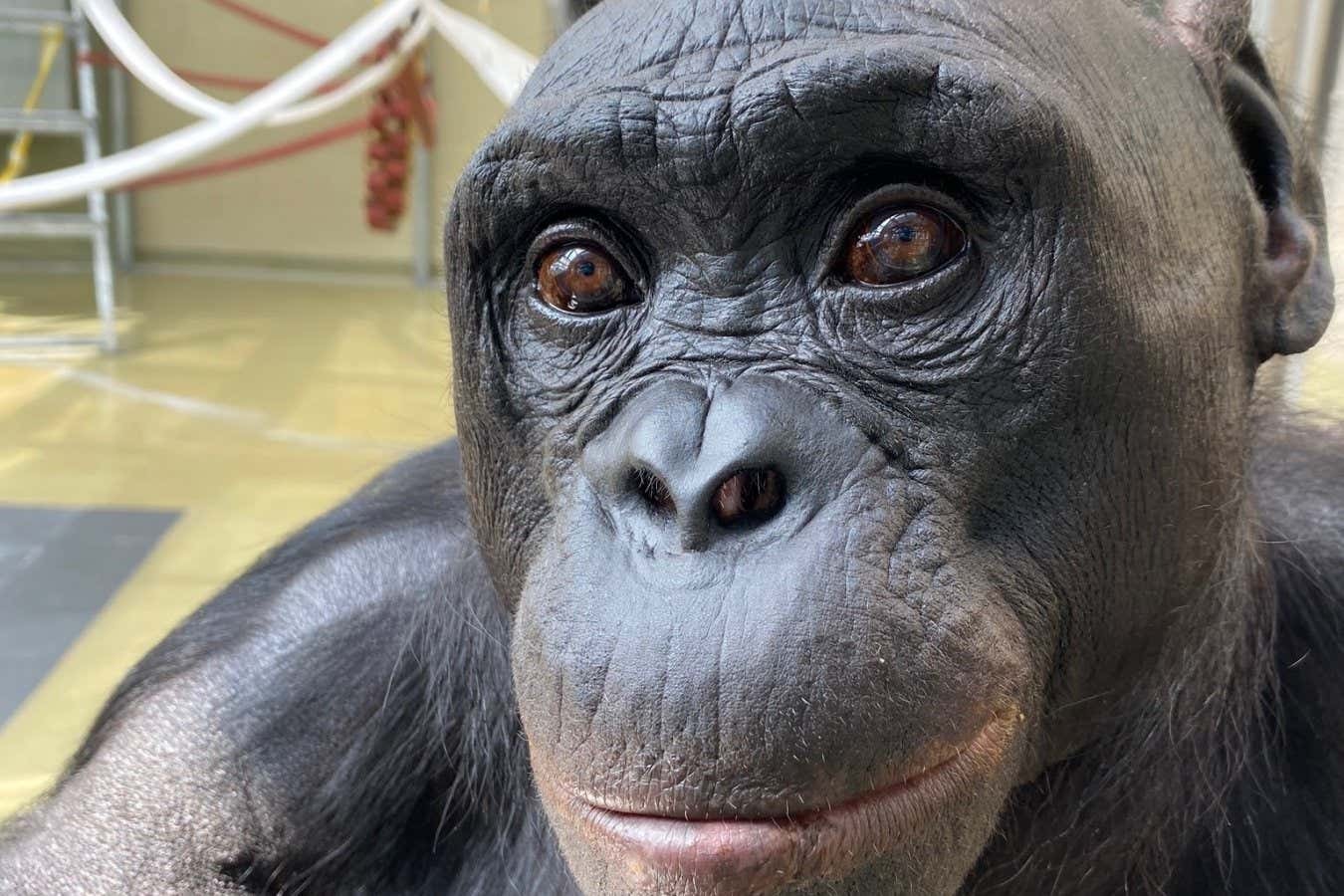
A groundbreaking study reveals that a bonobo named Kanzi exhibited the capacity for imaginative play, performing as well as young children in a “pretend tea party” experiment. The research, conducted shortly before Kanzi’s death at age 44, suggests that the cognitive foundations for imagination may be far older than previously thought – potentially present in our common ancestors millions of years ago.
The Experiment: A Test of “Secondary Representations”
Researchers at the University of St. Andrews, led by Amalia Bastos, designed a series of tests to determine if Kanzi could grasp the concept of “secondary representations.” This refers to the ability to understand and participate in a fictional scenario, such as pretending juice is poured into a cup even when the cup is empty.
The tests involved three stages:
- Pretend Juice: Researchers mimed pouring juice into two empty cups, then pretended to empty one. Kanzi consistently chose the cup that still appeared to contain juice, indicating he understood the pretense.
- Real vs. Fake Juice: Kanzi successfully distinguished between a cup with real juice and an empty cup over 75% of the time, confirming he could differentiate reality from pretense.
- Pretend Grapes: Similarly, Kanzi correctly selected the cup with a pretend grape after one had been emptied, demonstrating he could track imaginary objects.
Why This Matters: The Evolution of Imagination
The results are significant because imagination is often considered uniquely human. Kanzi’s success suggests that the biological capacity for imagination existed in our shared primate ancestors 6–9 million years ago. This doesn’t mean wild bonobos necessarily engage in tea parties; rather, Kanzi’s lifelong exposure to symbolic language and human interaction likely unlocked this potential.
“Kanzi stuck around and continued to engage even in trials where he knew there would be no reinforcement… he must have at least enjoyed it a little bit.” – Amalia Bastos
Implications for Understanding Cognition
The study highlights that imagination isn’t necessarily a high-level cognitive function exclusive to humans. It suggests that the underlying neural hardware for imagination is ancient, and cultural or environmental factors may be more important in triggering it. Researchers now aim to explore how and why these imaginative capabilities evolved.
This experiment is a clear demonstration that bonobos have understood the pretense and entered into the game, which mimics child play with doll houses, kids serving cups of tea to each other in tiny cups, and pretending to drink or offering pieces of cake that do not exist.