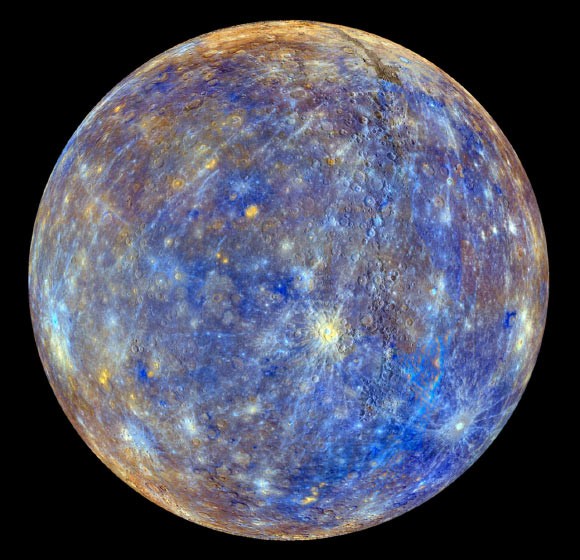
New research from Rice University suggests that the very foundation of Mercury’s geological history may be driven by a chemical quirk: an abundance of sulfur. By studying a specific meteorite, scientists have discovered that sulfur fundamentally alters how Mercury’s interior melts and solidifies, behaving in ways that contradict everything we learned from studying Earth.
The “Earth-Centric” Problem in Planetary Science
For decades, much of our understanding of planetary formation has been built on “Earth-centric” models. We assume that processes like magmatic evolution—how molten rock cools and forms a planet’s crust—follow patterns similar to those seen on Earth.
However, Mercury is a chemical outlier. As Professor Rajdeep Dasgupta, director of the Rice Space Institute, notes, Mercury’s surface looks nothing like Earth’s. Because spacecraft data can be difficult to interpret, researchers had to find a way to study Mercury’s internal processes without having direct samples from the planet itself.
Using a Meteorite as a Planetary Proxy
To bridge this gap, researchers turned to the Indarch meteorite, which landed in Azerbaijan in 1891. The Indarch meteorite is chemically “reduced”—meaning it lacks much of the oxygen found in Earth’s rocks—and shares a strikingly similar chemical makeup to Mercury. Scientists believe it may even be a remnant of the building blocks that formed the planet.
By recreating the extreme temperature and pressure conditions of Mercury in a laboratory, the team “cooked” chemical mixtures modeled after the Indarch meteorite. This allowed them to observe how Mercury-like magma behaves under realistic planetary conditions.
The Sulfur Effect: Breaking the Silicate Network
The most significant finding of the study is that sulfur lowers the temperature at which molten rock begins to crystallize. On Earth, magma stays liquid until it reaches a certain temperature, at which point it begins to turn into solid crystals. On Mercury, sulfur allows magma to remain molten at much lower temperatures.
The reason for this lies in the planet’s unique chemical balance:
– Low Iron Content: On iron-rich planets like Earth or Mars, sulfur is mostly “busy” binding with iron.
– High Sulfur Availability: Because Mercury has so little iron, the sulfur is “free” to seek out other partners.
– Replacing Oxygen: In Earth’s rocks, elements like magnesium and calcium bind with oxygen to create a stable “silicate network.” On Mercury, sulfur steps in and takes the place of oxygen in that network.
Because sulfur creates a weaker structural bond than oxygen does, the internal “scaffolding” of the rock is less stable, causing the magma to stay liquid longer and change how the planet’s mantle solidified over billions of years.
A New Paradigm for Planetary Evolution
This research shifts the way scientists approach the study of other worlds. Instead of forcing every planet into an Earth-based mold, this study proves that a planet’s specific chemical recipe—its unique ratio of elements—dictates its entire geological destiny.
“What water or carbon does to magmatic evolution of Earth, sulfur does on Mercury.”
Conclusion
By demonstrating how sulfur replaces oxygen in Mercury’s internal structure, this study provides a vital blueprint for understanding how chemically unique planets evolve. It highlights the necessity of studying each celestial body on its own chemical terms rather than relying solely on Earth-based comparisons.