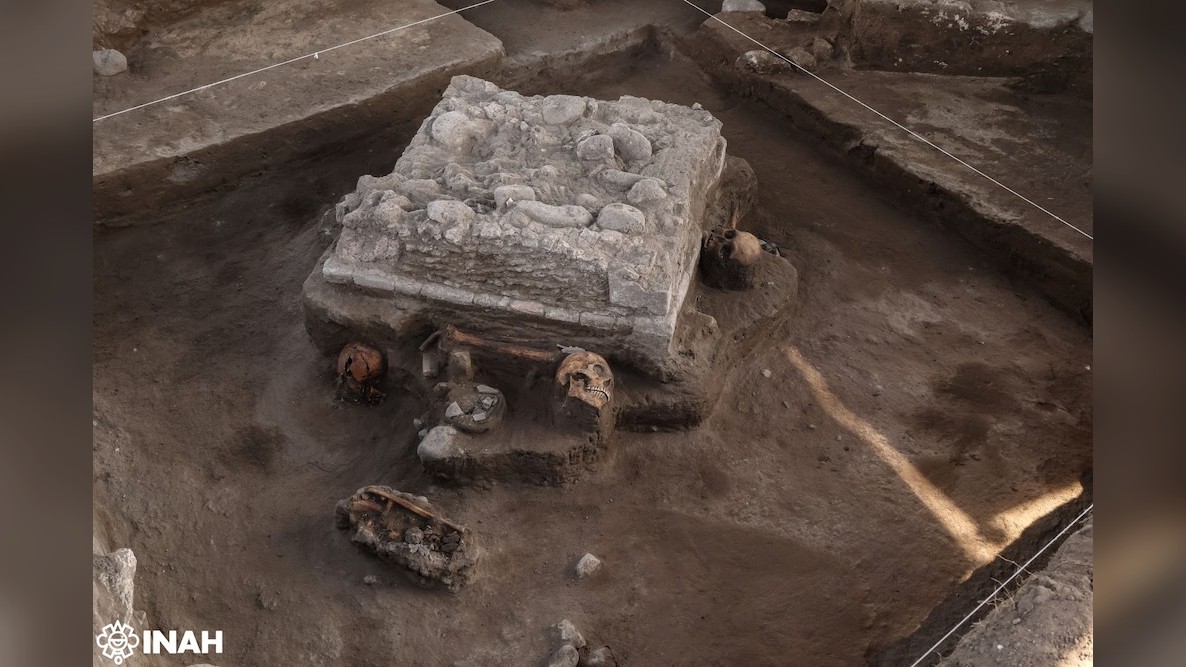
Archaeologists in Mexico have uncovered a 1,000-year-old stone altar used for human sacrifices during the reign of the Toltec Empire. The discovery provides new insight into the empire’s violent religious practices and military dominance. The site, located near Tula – about 55 miles north of Mexico City – was excavated during preparations for a transportation project.
The Altar and Its Remains
The altar, known as a momoztli in the Nahuatl language, measures approximately 10 square feet and consists of three layers of stone. Excavators found four human skulls and multiple leg bones arranged around three sides, strongly suggesting these were sacrificial offerings. The arrangement implies a deliberate ritualistic placement.
Archaeologist Víctor Francisco Heredia Guillén explained that the bones’ precise location suggests further, unseen remains may lie beneath the surface.
Context of the Discovery
The altar was surrounded by the remains of walls, indicating it stood within a courtyard connected to what might have been an elite residential complex or palace. The Toltec Empire flourished between 950 and 1150 AD, filling the period between the fall of Teotihuacán and the rise of Tenochtitlán.
“Each discovery like this expands our knowledge of one of the great civilizations of Mesoamerica,” said Claudia Curiel de Icaza, Mexico’s secretary of culture.
Rituals and Warfare
The newly discovered altar likely dates back to the height of Tula’s power. The Toltec were known as formidable warriors, and human sacrifice may have been a practice used to intimidate enemies or honor military victories. One skull remains partially attached to a spine, suggesting decapitation was a common method of sacrifice.
Archaeological evidence shows obsidian or flint knives were used, leaving distinct cut marks on the recovered bones.
Further Research
Researchers plan to conduct anthropological and chemical analyses to determine the victims’ gender, origin, and potential status. This deeper examination could reveal whether sacrifices were local prisoners or captives brought from distant territories.
The findings underscore the brutal realities of Mesoamerican empires, where warfare, religion, and political power were interwoven with ritualized violence. The excavation will continue to shed light on one of the region’s most historically significant civilizations.